

This article examines the imbalance in President Isaias Afwerki’s recent media interview, where extensive attention was given to global and regional geopolitics while domestic Eritrean issues received comparatively limited focus. Acknowledging the importance of strategic global awareness, the piece argues that Eritrea has reached a stage where internal priorities development timelines, institutional reform, human capital, and citizen experience must receive equal analytical weight. The article offers a pragmatic, Eritrea-first critique aimed not at undermining leadership, but at strengthening national alignment and ensuring that sovereignty is matched by tangible progress in everyday life

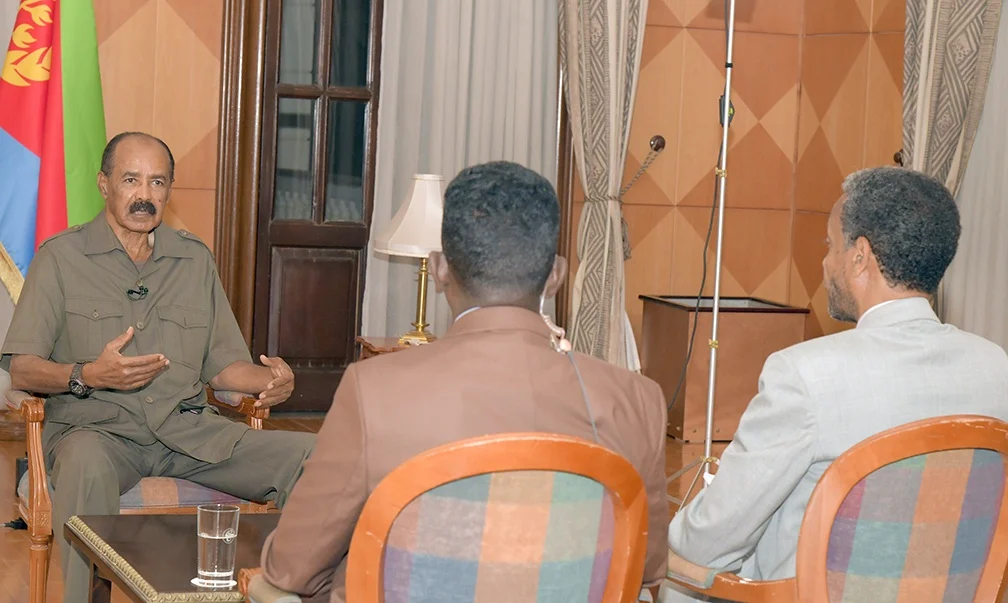
Earlier this week, President Isaias Afwerki delivered a wide-ranging interview to local media that was unmistakably global in scope and strategic in tone. He spoke at length about the end of the unipolar world order that emerged after 1991, the relative decline of U.S. dominance, the logic and limits of Donald Trump’s doctrine, NATO’s internal contradictions, Africa’s structural marginalization, and the enduring geostrategic importance of the Red Sea and the Horn of Africa.
This kind of analysis matters. Eritrea has never had the luxury of strategic innocence. From the armed struggle to the post-independence years of sanctions, isolation, and regional confrontation, Eritrea’s survival has depended on reading global power shifts accurately and responding to them without illusion. On this front, the president sounded confident, experienced, and consistent with a worldview shaped by history rather than fashion.
Yet there is an imbalance in the interview that deserves careful attention not as an attack, but as a necessary national conversation. Domestic Eritrean issues received far less analytical depth and urgency than regional and international ones. In Eritrea’s current phase, that imbalance matters.
Global clarity versus domestic distance
The president’s global analysis was coherent and internally consistent. He traced the trajectory from the Cold War to unipolarity, and from unipolar dominance to fragmentation and contestation. He warned against exaggerating Trump’s actions while still situating them within a broader effort to reassert American leverage through tariffs, sanctions, selective alliances, and resource pressure. He also underscored a long-standing Eritrean observation: that Africa, despite possessing the majority of the world’s natural resources, remains structurally marginalized within the global system.
Analytically, this framing is difficult to dispute. But analysis does not exist in a vacuum. The tension emerges when this global clarity is contrasted with the treatment of domestic realities. Most Eritreans are not navigating tariff wars, NATO’s crisis, or U.S.–China rivalry in their daily lives. They are navigating water access, electricity shortages, job uncertainty, family separation, constrained mobility, education bottlenecks, and delayed life transitions.
When domestic realities appear later in the conversation and in broader strokes the perception that forms is not necessarily the one intended. The risk is that urgency appears external rather than internal, and that domestic challenges are implicitly framed as stable enough to wait. For a society that has absorbed decades of sacrifice in the name of sovereignty and survival, perception carries real weight.
Development vision without temporal anchors
To be clear, the interview did outline a comprehensive domestic development agenda. Roads, dams, energy generation, mining, agriculture, fisheries, housing, and education were all cited as priorities. The scale of ambition is evident, and in many respects admirable. Eritrea has never lacked long-term vision.
The pragmatic critique is not about ambition, but about communication. Vision alone no longer carries the same mobilizing power it once did. Eritreans today are not primarily asking what will be built; they are asking when, how, and in what sequence. Timelines, even broad ones, serve a critical function: they translate national goals into personal expectations.
The absence of phased benchmarks or short-term deliverables weakens confidence, not because people doubt intent, but because lived experience increasingly demands clarity. In a mature national phase, credibility is reinforced by specificity. Three-year horizons, pilot regions, or sector-by-sector sequencing can turn abstract commitment into measurable trust.
Stability and the question of reform
Stability was repeatedly emphasized as the foundation of development, and rightly so. Eritrea’s history demonstrates that without security and cohesion, development collapses into dependency or chaos. However, stability cannot be treated as an end state. At this stage, it must function as a platform for institutional evolution.
The interview spoke little about administrative efficiency, legal predictability, civil governance modernization, or institutional renewal. These are not imported demands or ideological concessions. They are internal performance tools. A resilient state is not only one that resists external pressure, but one that adapts its internal systems so citizens can function productively, predictably, and with dignity.
The absence of this discussion leaves a noticeable gap, particularly for professionals, entrepreneurs, and skilled workers who want to contribute but encounter friction from outdated procedures and opaque processes. Over time, such friction erodes energy and initiative, even among the most committed citizens.
Human capital beyond schooling
Education was correctly identified as the highest priority, and this emphasis reflects long-standing Eritrean values. But education cannot be examined in isolation from social and economic pathways. Young Eritreans today face long delays before entering civilian economic life, limited career pathways outside a narrow set of sectors, and skills that do not always align with labor market demand.
Human capital development is not only about classrooms and curricula. It is about transition how people move from learning to living, from training to contribution. This transition phase is where frustration accumulates and morale is tested. The interview largely bypassed this dimension, even though it sits at the heart of national productivity and social cohesion.
Addressing these pressures directly would not weaken the state. On the contrary, it would strengthen it by aligning policy vision with lived reality.
Diaspora: resource or partner?
The diaspora’s historic and ongoing contributions were rightly acknowledged. Investment, technology transfer, skills, and expertise were presented as pillars of future engagement. Yet engagement framed primarily in financial or technical terms risks missing a deeper opportunity.
Many Eritreans abroad are not only sources of capital; they are repositories of experience, institutional knowledge, and comparative insight. They seek structured dialogue, policy feedback mechanisms, and meaningful participation not simply investment channels. A diaspora treated only as capital risks fatigue and disengagement. A diaspora treated as a partner becomes a strategic multiplier.
Realizing this requires institutional frameworks, data systems, and channels of communication that go beyond ad hoc appeals. It requires trust built through inclusion, not only through obligation.
Security discourse and domestic acceleration
The president’s dismissal of hostile rhetoric from Ethiopia’s ruling party and his reaffirmation of Eritrea’s readiness to defend itself while avoiding war were consistent with long-held positions. Few Eritreans underestimate the volatility of the region or the reality of external threats.
Still, there is a strategic cost when security discourse dominates national messaging. National resilience is built not only through deterrence, but through reliable services, livelihoods, and institutional trust. Deterrence without domestic acceleration becomes expensive economically, socially, and psychologically.
Security and development are not competing agendas, but they must advance in tandem. Overemphasis on one risks stagnation in the other.
Eritrea’s current inflection point
Eritrea’s preservation of sovereignty under extraordinary pressure is a genuine achievement. Few nations of comparable size and exposure have endured similar constraints without fragmentation or collapse. That history deserves recognition.
But the next phase of Eritrea’s journey is different. The defining challenges ahead are less about resisting external imposition and more about internal calibration: how fast systems adapt, how clearly priorities are communicated, and how citizens experience progress in their daily lives.
The interview leaned heavily toward geopolitical diagnosis. Eritrea’s decisive work in the coming years will be administrative, economic, and social. These are quieter battles, but no less consequential.
Criticism as a form of responsibility
This critique is not an argument against leadership, nor is it a dismissal of the president’s global analysis. It is an argument for balance. Eritrea does not need less global awareness; it needs equal domestic intensity.
When domestic issues receive the same analytical rigor as geopolitics, public trust deepens. When development plans are paired with timelines, confidence grows. When reform is framed as an expression of strength rather than concession, sovereignty matures.
This is not a call for noise or spectacle. It is a call for alignment between where Eritrea looks and where Eritreans live. That conversation is not only healthy; it is necessary for the next chapter of Eritrea’s national project.
………………………………………………………………………………………………………………………………………………………………………………………..
Sources: Setit